Summary: Offer your children a wide range of toys that encourage creativity, imagination, and active play.
Offer your child a variety of toys to support different types of development and thinking. Make sure the toys match the child cognitively. Also, avoid toys that may be marketed well but limit your child’s development.
The following are different categories of children’s toys. Try to offer your child toys from each group to encourage development in all areas.
Sensory/physical: balls, sand play, etc.
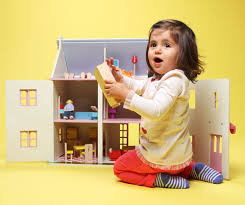
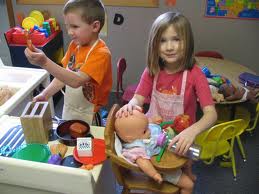
Representational: dress up clothes, plastic phones, emotionally charged toys (wands, baby items, etc.)
Construction: unit blocks, Tinker-Toys
Gross/fine motor: balance beam, painting
Different toys cue children to play in different ways. A ball cues children to run and kick. A puzzle promotes fine motor skills and is more suggestive of solitary play. Dress up clothes, wands, etc., “invite children to incorporate their own fantasies, images, roles and scripts into their play” (Van Hoorn, p.324).
Toys can also be categorized as closed-ended (convergent) or open-ended (divergent). Some toys are closed-ended, meaning there is only one way to play with them, such as locks and keys. Open-ended toys are important because children can apply their own meanings and actions to the toys. This empowers children and fosters creativity. Crayons, paint, construction, and dress-up toys are examples of open-ended toys.
Choose toys that children are intellectually capable of playing with. According to Piaget, children have biological timetables for how they perceive the world. Children two and under cannot abstract or imagine. They are physical, so you can offer them balls, trucks, items with texture, or other motor- and sensory-based toys. From 3 to 6, children begin to abstract and imagine, so you can provide cardboard boxes, dress up, and open-ended toys.
REFERENCE
Van Hoorn, J., Nourot, P. M., Scales, B., & Alward, K. R. (2011). Play at the Center of the Curriculum. Upper Saddle River, NJ: Pearson.